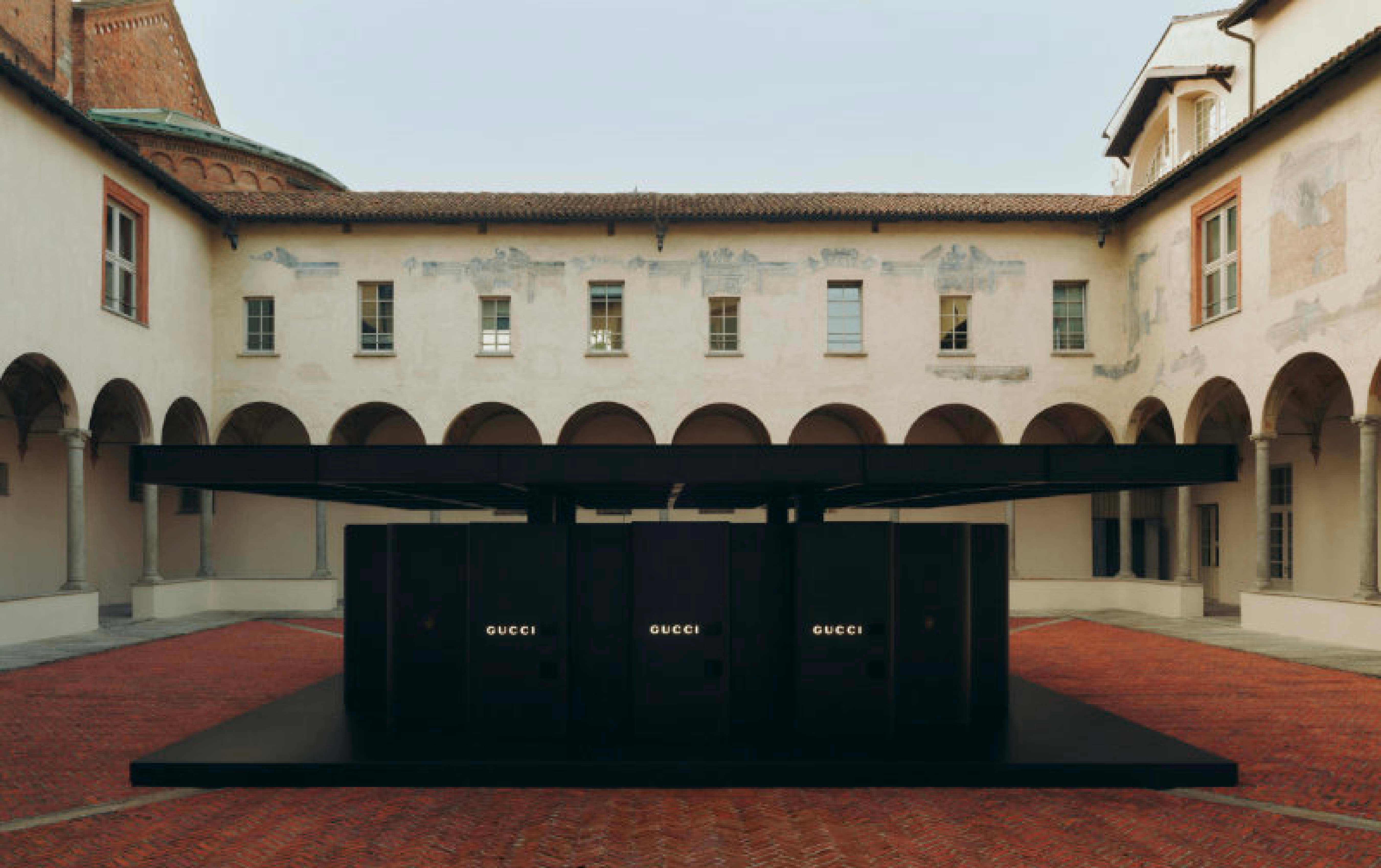


At Milan Design Week 2026, Gucci, under the direction of Demna, did not simply participate—it set the tone. Gucci Memoria emerges as a defining statement within Fuorisalone, recalibrating how heritage is engaged, shifting it from static reference to an active, living material.
Staged within Chiostri di San Simpliciano in Brera, the exhibition unfolds as a continuous spatial narrative where time collapses into a singular, immersive field. Rather than a retrospective, it constructs a fluid choreography of memory—immediate, atmospheric, and deliberately unresolved.
Twelve large-scale tapestries anchor the installation, tracing the House’s 105-year trajectory from Guccio Gucci to the present. Developed with Tessitura Grassi, each piece transforms craftsmanship into a primary language, using dense weaving techniques to heighten texture and chromatic depth. History here is not illustrated—it is materially built.
Creative legacies—from Tom Ford to Frida Giannini, Alessandro Michele, and Sabato De Sarno—merge into a single evolving system. Chronology dissolves in favor of continuity, where identity is in constant flux and no era dominates.
A botanical layer, informed by the Gucci Flora motif, introduces a sensorial dimension that aligns natural cycles with the exhibition’s temporal logic. Live violin performances move through the cloister, subtly disrupting stillness and reshaping perception without tipping into spectacle.
Gucci Memoria ultimately positions memory as a forward-facing medium—precise, constructed, and entirely contemporary.